Nivaw.com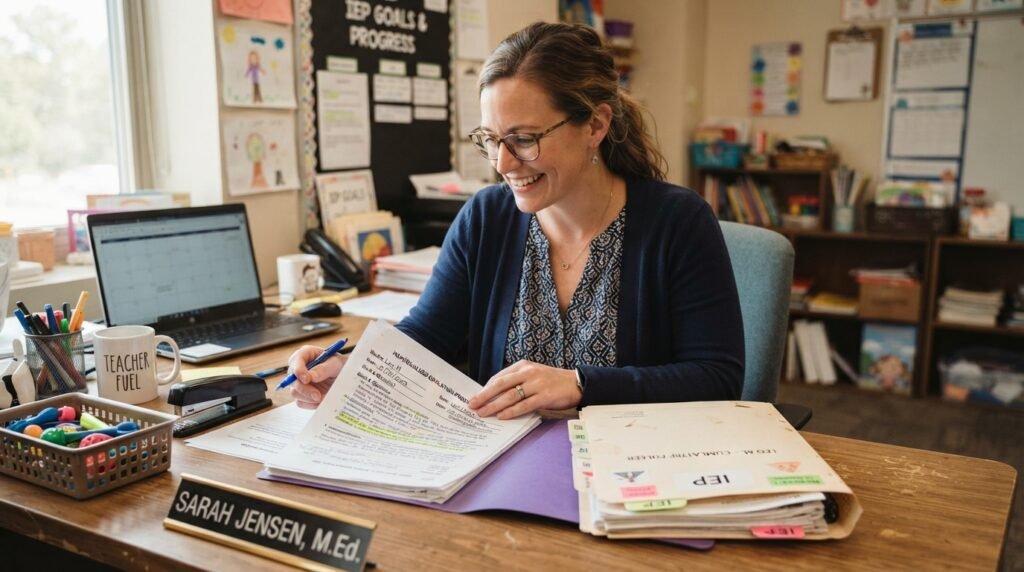
Mary Acebu teaches special education at a middle school in Bay Point, California. Like most SPED teachers, she’s drowning in paperwork that has nothing to do with actually teaching, and increasingly, she’s using AI to help her come up for air. She calls the tools her “little assistants.” They draft worksheets. They help sketch out IEP goals. And then, in her words, she double-checks everything, because that human touch has to be the final step.
She’s far from alone. According to a national survey by the Center for Democracy and Technology, 57% of special education teachers used AI to help develop individualized education plans during the 2024–25 school year, up sharply from 39% the year before. If you’re a SPED teacher who hasn’t tried it yet, you’re now in the minority.
Quick answer: Yes, it’s legal and increasingly common to use AI to draft IEP goals; neither IDEA nor FERPA prohibits it, as long as a human reviews, personalizes, and approves everything before it becomes part of an official document. AI is genuinely good at the structural, repetitive parts of goal-writing (SMART format, measurable criteria, standards alignment) and genuinely bad at knowing your student. Used as a first-draft generator rather than a finished product, it can meaningfully cut the hours you spend on documentation without compromising the individualization the law requires.
Why this workload exists in the first place
IEP documentation isn’t optional busywork; it’s federally mandated under IDEA, and it’s also genuinely necessary for kids to get the services they need. But the volume is real. Special education teachers report spending somewhere between 5 and 10 hours a week on IEP paperwork alone, on top of actual teaching. With caseloads of 15 to 30 students, and each IEP requiring goals across multiple domains, that adds up to hundreds of hours a year just on drafting.
That’s the gap AI tools are stepping into, not to replace the professional judgment an IEP requires, but to take the blank page out of the process. It’s a different situation from the debate over whether teachers can actually detect AI-written essays, but the underlying lesson is the same: AI output needs a human check before it becomes part of an official record.
What AI is actually good at here
The parts of IEP writing that are structural and repetitive are exactly where AI tools perform best:
- SMART goal formatting. Turning “improve reading comprehension” into a properly measurable goal with a baseline, a specific skill, a percentage or count target, and a timeframe the kind of formatting new teachers often struggle to get right and experienced teachers can write in their sleep but still find tedious.
- Present Levels (PLAAFP) drafting. If your district uses a diagnostic tool that outputs performance data, AI can turn that data into readable first-draft narrative language far faster than writing it from scratch.
- Behavior intervention plans and social stories. Structured documents with a predictable format are a good match for AI drafting, especially when they follow a template your district already uses.
- Progress report and parent communication language. Translating technical progress data into plain, parent-friendly language is something AI tools handle reasonably well as a starting point.
Where it genuinely falls short
Every teacher who’s used these tools says some version of the same thing: the output is a solid first draft, not a finished document. A few specific gaps show up consistently:
It doesn’t know your student. An AI tool can produce a structurally perfect goal for “third grade student, reading comprehension, on grade level minus two.” It has no idea that this particular student shuts down after multiple-choice format questions, or that they respond better to goals framed around a specific interest. That knowledge is the actual “individualized” part of an Individualized Education Program, and it has to come from you.
Low-incidence disabilities need more editing, not less. For common, well-documented goal areas, AI output tends to be strong. For less common disability profiles, the drafts require significantly more revision, which makes sense, since the tool has less to draw on.
Legal language matters, and AI can drift. IDEA has specific requirements for what counts as measurable, and state standards vary. A draft goal that reads well in plain English isn’t automatically compliant. This is a review step you can’t skip, no matter how good the draft looks.
The tools teachers are actually using
A few names come up repeatedly in surveys and teacher reports right now:
- MagicSchool AI, a general teacher tool with a dedicated IEP goal generator, accommodation writer, and BIP assistant built in. Popular partly because it’s inexpensive and FERPA-compliant, with a usable free tier.
- Playground IEP / IEP CoPilot built specifically around the IEP workflow rather than general teaching tasks, including caseload management alongside goal drafting.
- OpenEduCat, EasyClass AI, and similar goal generators are narrower tools focused specifically on producing SMART goal drafts across the standard IEP domains (reading, math, writing, speech/language, behavior, self-regulation, transition).
None of these replace your IEP software of record or your district’s approval workflow; they sit upstream of it, generating the draft you then bring into the real document.
A workflow that keeps you in control
- Start with real data, not a vague prompt. The better the input (current performance level, specific skill gap, recent assessment data), the less editing the output needs.
- Generate the structural draft. Let the tool produce the SMART-format goal, baseline, and measurable criteria.
- Rewrite the parts that require knowing the student. Adjust the language, add the specific strategies and interests you know how to work with, and make sure the goal reflects where you actually want this student to be in a year, not just where the data says they are now.
- Check it against your state’s IEP requirements and your district’s goal bank. Standards and required language vary by state; don’t assume the AI output already matches yours.
- Bring it to the IEP team as a draft, not a final document. The legal requirement is that the team reviews and determines whether the content AI can produce language, but it can’t wait for the meeting or sign off on your behalf.
The bottom line
Using AI to draft IEP goals isn’t a compliance risk by itself; it’s a time-management strategy that’s becoming standard practice, not a fringe one. The risk shows up only when a draft goes out the door without a teacher actually applying their knowledge of that specific kid. Treat the AI output the way you’d treat a template: a strong starting point that saves you from staring at a blank page, not a substitute for the judgment that makes an IEP individualized in the first place.
Frequently Asked Questions
Is it legal to use AI to write IEP goals?
Yes. Neither IDEA nor FERPA prohibits the use of AI as a drafting tool, as long as the IEP team reviews, edits, and approves the final content and the document remains genuinely individualized to the student.
What is the best AI tool for writing IEP goals?
There isn’t a single best tool for every situation. MagicSchool AI is a popular, affordable starting point with a free tier and broad teacher tools beyond IEPs, while dedicated platforms like Playground IEP or OpenEduCat focus specifically on the IEP workflow. The right choice depends on whether you want an all-in-one teaching tool or a SPED-specific system.
Can AI replace a special education teacher’s judgment in writing IEPs?
No. AI tools can draft the structural, measurable-goal language efficiently, but they don’t know an individual student’s needs, preferences, or history; the core of what makes an IEP individualized still has to come from the teacher and the IEP team.
How much time can AI actually save on IEP paperwork?
Reports vary, but teachers and vendors commonly describe cutting first-draft goal-writing time significantly, sometimes from several hours per student down to one or two, though the total time saved depends heavily on how much editing a given student’s goals require.
Do AI-generated IEP goals need to be reviewed before use?
Yes, always. Every AI-generated goal, accommodation, or plan should be treated as a draft requiring review by the teacher and formal approval by the full IEP team before becoming part of an official document.
This article is for general information and reflects publicly reported research and tools as of 2026. It isn’t legal advice; check with your district’s special education administration for guidance specific to your state and school.