Nivaw.com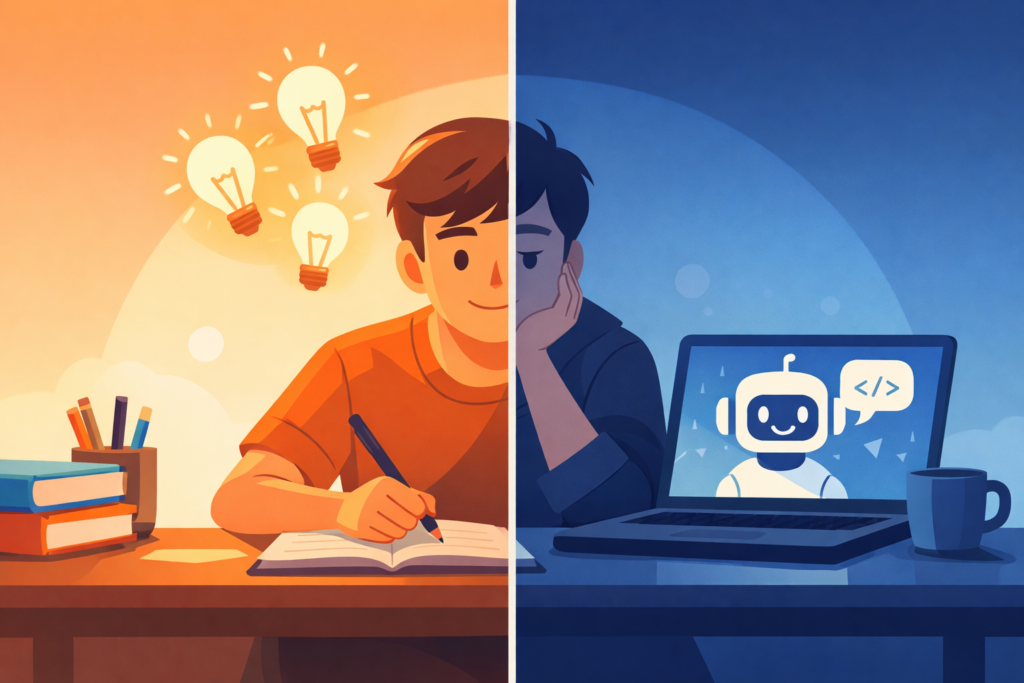
Last week, a student asked me to check her essay before submitting it. Within thirty seconds, she’d fed the prompt into ChatGPT, gotten a full draft, tweaked two sentences, and called it done. It read fine. Grammatically clean, decent structure, nothing wrong with it on the surface.
But she couldn’t tell me what her thesis was.
That moment sums up the whole debate around AI and student learning. Something is clearly changing in how students work; the question is whether it’s making them sharper or just teaching them to skip the hard part. The answer isn’t as simple as either side wants it to be.
The Case That AI Is Making Students Lazier
Talk to any teacher who’s been in the classroom for more than a few years, and you’ll hear some version of the same complaint: students are outsourcing the thinking, not just the typing.
The concern isn’t really about AI writing an essay. It’s about what gets skipped when a tool hands over a finished answer. Struggling with a problem, sitting with confusion, trying and failing before trying again that friction is where a lot of real learning happens. When AI removes it entirely, students get the output without the process that made the output meaningful.
There’s also a subtler issue: verification laziness. Students increasingly trust AI-generated answers without checking them, treating a chatbot’s response the way older generations treated an encyclopedia entry as settled fact rather than a starting point. That’s a dangerous habit to build early, especially since AI tools can be confidently wrong.
And then there’s the shortcut culture problem. Once a student learns that a five-second prompt can replace a two-hour assignment, it’s hard to unlearn that. Motivation to grind through difficult material drops when an easier path is always one tab away.
The Case That AI Is Making Students Smarter
Now flip it around, because the opposite argument holds up just as well.
Used well, AI is one of the most personalized tutors a student can access. A struggling student can ask the same question ten different ways until it clicks, something that’s simply not realistic with one teacher and thirty kids in a room. That kind of instant, judgment-free feedback loop didn’t exist a decade ago.
AI also removes barriers that used to quietly filter out certain students. A kid without access to expensive tutoring can now get help explaining a concept at 11 PM before an exam. A student who struggles with language processing can ask AI to break down a dense textbook paragraph into plain language. For students learning in a second language, a real factor for many Bac students working across Arabic, French, and English materials is that kind of on-demand translation and simplification is genuinely leveling.
There’s also evidence that AI is changing what students spend their mental energy on. Instead of burning an hour formatting citations or untangling awkward grammar, students can put more time into the actual argument or idea. That’s not laziness; that’s redirection.
What the Research Actually Says
This is where it gets interesting, because the data doesn’t cleanly support either side.
Several early studies on AI-assisted learning have found a split outcome: students who use AI as a checking tool, asking it to review their own work, explain a concept they already attempted, or quiz them tend to show learning gains. Students who use AI to generate the work outright, skipping the attempt entirely, tend to show little to no improvement in the underlying skill, even though their submitted work looks fine on paper. [VERIFY SOURCE link to a specific published study, e.g. from an education research journal or university study, before publishing]
In other words, the tool isn’t the variable. The behavior around the tool is.
This mirrors something researchers have seen before with calculators and search engines: every generation panics that a new tool will erode a fundamental skill, and the real story ends up being about how the tool gets used in practice, not the tool itself.
The Real Factor That Matters More Than AI Itself
If there’s one thing that actually predicts whether AI helps or hurts a student, it’s this: does the student use AI before attempting the problem, or after?
Ask AI to solve something cold, and you get an answer with zero learning attached. Attempt it yourself first, then use AI to check your reasoning, explain where you went wrong, or push you further, and the tool becomes an accelerant instead of a replacement.
Age and self-regulation matter too. Younger students or those without strong study habits are far more likely to slide into pure shortcut use, simply because the discipline to attempt-first isn’t fully developed yet. Older students, especially those already invested in a goal like the Baccalaureate, tend to self-correct faster once they notice AI-generated answers aren’t actually helping them retain material under exam pressure.
The teacher or parent’s role hasn’t disappeared; it’s just shifted from “gatekeeper of information” to “coach on how to use the tool well.”
Practical Takeaways for Students and Teachers
For students:
- Attempt the problem yourself first, even badly, before asking AI for help
- Use AI to explain why an answer is right, not just to get the answer
- Treat AI output as a draft to question, not a final answer to submit
- Use AI to quiz yourself on material you’ve already studied, not to skip studying it
For teachers:
- Design assignments that require process, not just a final product (drafts, reasoning steps, oral defense of an essay)
- Teach AI literacy explicitly how to verify, question, and iterate on AI output
- Normalize AI as a study tool in class so students aren’t just using it secretly, unsupervised, at home
For parents:
- Ask your child to explain their answer out loud, not just show you the finished work
- Keep an eye on whether AI use is replacing effort or replacing tedium; those are very different things
So, Smarter or Lazier?
Neither, really, or both, depending entirely on the student holding the tool. AI hasn’t changed whether students can think critically. It’s changed how easy it is to avoid doing so, and how much support is available for those who choose not to avoid it.
The students who come out ahead in a few years won’t be the ones who avoided AI entirely, and they won’t be the ones who let it do everything either. They’ll be the ones who learned to use it as a mirror instead of a shortcut, one that shows them what they actually understand, not just what they can copy and paste.